Greenhouse and farm simulation
Agriculture and greenhouses
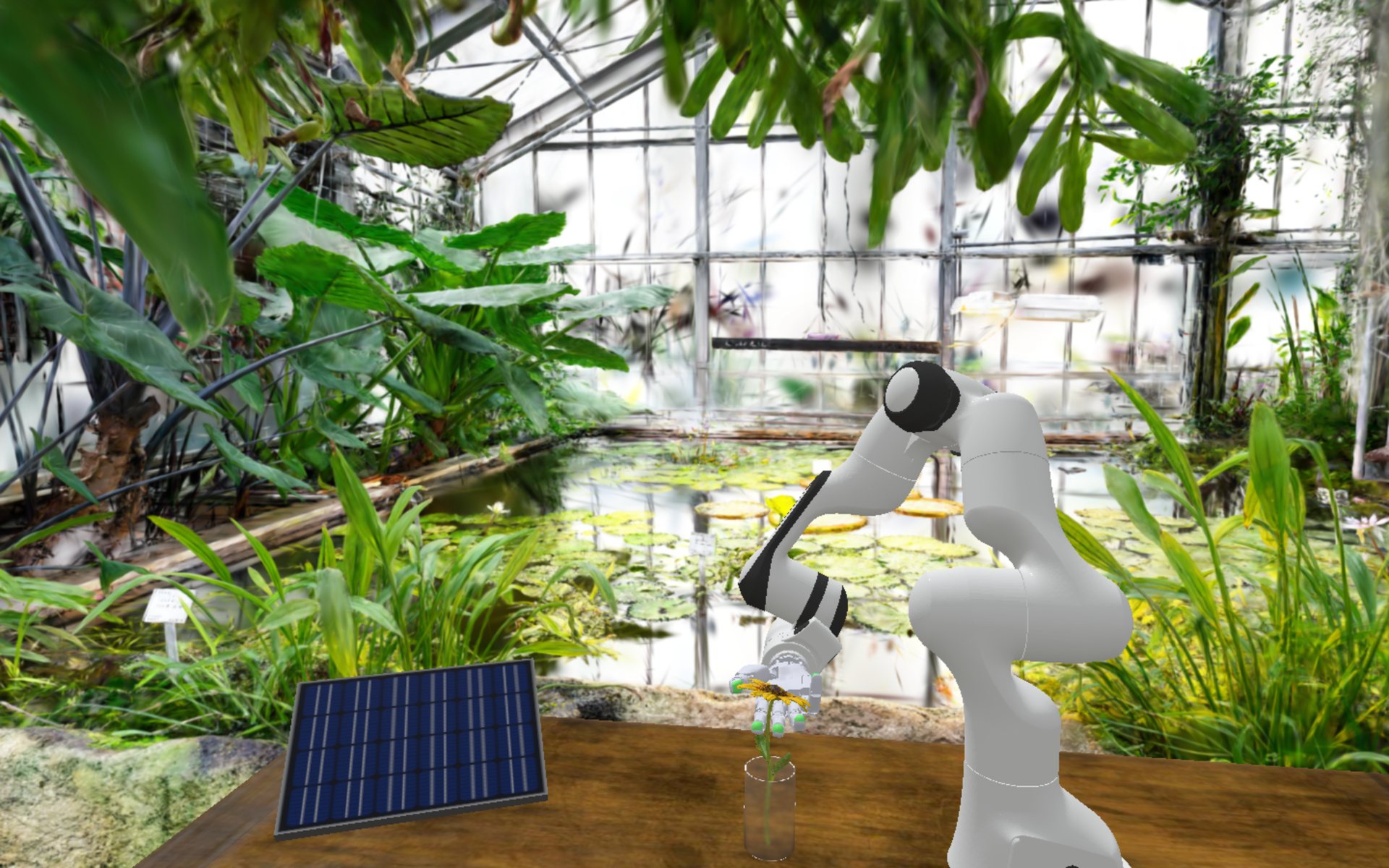
Greenhouse robots handle soft plants that differ from one to the next. SceneAgent turns a capture of a plant into a simulation asset with labelled parts. Our greenhouse scene sets a converted Rudbeckia in a captured greenhouse. Its physics values were set by hand for a MuJoCo run. They were not predicted.
What agricultural simulation teams build
Farm robots often work outdoors, in rows and orchards. Bonsai Robotics hires for simulations of orchards and row crops on uneven terrain, under changing light and weather.
Greenhouse robots work at close range on single plants. Wageningen University & Research built a simulated greenhouse for a tomato-harvesting robot. It models plant structure, variation and physical properties. The stated reason is that real greenhouses change, so a test in one cannot be repeated.
Recent papers build these scenes in two ways. AgriGen generates crop scenes procedurally in Isaac Sim. GreenhouseSplat builds greenhouse assets from low-cost photographs with Gaussian splatting.
Who builds agricultural simulations
What each source says the team builds in simulation. None of these sources mentions SceneAgent.
- Bonsai RoboticsSimulation environments of orchards, row crops, uneven terrain, variable lighting and weather. The post also covers software- and hardware-in-the-loop tests and sensor models calibrated to hardware.Bonsai Robotics job post, via Y-Axis Jobs ↗
- Wageningen University & Research with DENSO and CerthonA simulated greenhouse with plant structure, variation and physical properties, built for a tomato-harvesting robot. Real greenhouses change, so tests in them cannot be repeated.WUR news, 3 April 2026 ↗
- AgriGenLarge procedural agricultural scenes of row crops, orchards and vineyards, with physics and domain randomization. The paper names Isaac Sim and ROS.arXiv 2609.25725, 22 September 2026 ↗
- Cherry-tomato harvesting robotThe robot was validated in Isaac Sim first. It then ran 50 trials at a commercial greenhouse in Abu Dhabi.arXiv 2610.18160, 13 October 2026 ↗
- GreenhouseSplatPhotoreal greenhouse assets made from low-cost RGB images with Gaussian splatting. They are built for ROS-based simulation with camera and LiDAR.arXiv 2510.01848, 2 October 2025 ↗
- NVIDIA Isaac LabA pull request adds a berry-picking task with Gaussian splats, made for a GTC Berlin demo.GitHub, isaac-sim/IsaacLab #8300 ↗
A converted flower in a captured greenhouse
These steps follow the greenhouse scene on this site. Its values come from the greenhouse annotations file.
- 01
Capture the place
The greenhouse is a 3D capture by simonbethke. Four hand-placed props stand in it. They are a wooden table, a glass of water, the Rudbeckia and a small solar panel.
- 02
Convert the plant
The Rudbeckia came from a separate 3D capture. The prompt asked SceneAgent to make it a usable simulation asset for Isaac Lab.
The converted flower has six labelled parts. They are the stem, the hairs on the stem, the bracts, the disc florets, the ray florets and the pollen.
- 03
Set the physics by hand
No physics was predicted for this scene. We set the values by hand for the MuJoCo run. The simulation script calls them assumptions, not measured material properties.
The glass is an open cavity of 64 wall wedges on a solid base. The flower collides as a compound of convex pieces. The water is a lumped mass with buoyancy and drag on the stem. It is not a fluid simulation.
- Glass of water
- 245 g, 132 g of glass and 113 g of water
- Glass friction
- 0.25
- Rudbeckia
- 4 g, friction 0.65
- Wooden table
- Static, friction 0.7
- Solar panel
- No body in the simulation
- 04
Lift by contact
The run is a contact simulation in MuJoCo at 1,000 steps a second. A Panda arm and a Sharpa Wave hand are driven by 29 torque-limited servos.
The hand slides under the bloom, cups the flower and lifts it out of its glass. Nothing attaches the flower to the hand.
- 05
Vary the task
The SceneAgent paper uses this flower in its policy loop. A pinch by the stem fails, and the flower stays in its glass.
Digital sisters change the flower's position for new trials. A revised grasp then supports the bloom from below with the palm and fingers.

Farm robots and farm labour in numbers
- About 17,000agricultural service robots sold in 2025, up from about 14,000 in 2024. IFR shows these on a chart, so both are approximate.IFR World Robotics 2026, service robots ↗
- 435,980H-2A farmworker positions certified in fiscal 2026, against 398,258 in fiscal 2025US Department of Labor ↗
- 50trials of a cherry-tomato harvesting robot at a commercial greenhouse, after validation in Isaac SimarXiv 2610.18160 ↗
More on the method
“A digital twin of your site for policy evaluation” follows this flower through the paper's policy loop. “Sim-ready assets from real objects” explains where each kind of physics value comes from, including values set by hand.
Both pages are linked below, with the greenhouse and the flower in 3D.
Questions
What is a greenhouse digital twin?
A greenhouse digital twin is a simulation of a real greenhouse, with its plants and fixtures. Wageningen University & Research built a simulated greenhouse for a tomato-harvesting robot because real greenhouses change and tests in them cannot be repeated. Our greenhouse scene combines a captured greenhouse with a converted Rudbeckia.
Can I build an Isaac Sim agriculture environment from a capture?
SceneAgent packages scenes as USDZ for Isaac Lab, MuJoCo and Unreal Engine. The flower in our greenhouse was converted as an asset for Isaac Lab. The greenhouse run itself was recorded in MuJoCo. We have not converted a field or an orchard.
Were the greenhouse physics values predicted?
No. The greenhouse is the one scene on this site without predicted physics. The values were set by hand for the MuJoCo run. The simulation script calls them assumptions, not measured material properties.
How does the hand hold the flower without an attachment?
By contact alone. The run is a contact simulation in MuJoCo at 1,000 steps a second, with 29 torque-limited servos in the arm and hand. The water is a lumped mass with buoyancy and drag on the stem. It is not a fluid simulation.
What goes into an orchard simulation?
Bonsai Robotics describes simulations of orchards and row crops, with uneven terrain and changing light and weather. AgriGen generates orchards, vineyards and row crops procedurally in Isaac Sim. There is no orchard scene on this site.