Construction and field simulation
Construction and field robotics
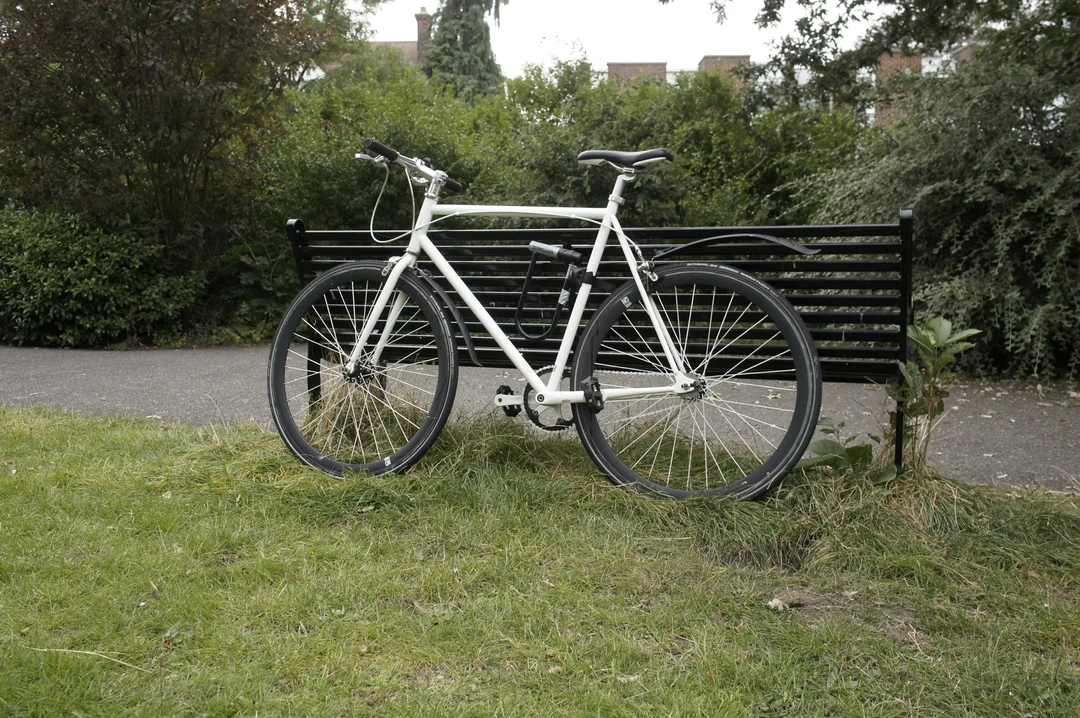
Construction and field teams simulate the sites their machines work on. Several build those simulations from scans and splats of the real sites. We have not converted a construction site. This page shows the method on an outdoor capture of a bicycle in a park and on our warehouse.
What construction and field simulation teams build
Excavator teams model the ground their machines dig. Bedrock Robotics hires to compare simulation runs with field data and to calibrate parameters such as terrain material properties. Gravis Robotics trains excavator autonomy with reinforcement learning across sites with different soils.
Scans of real sites are a common input. Bedrock hires an intern to train NeRF and Gaussian splat models on site data captured by its fleet. A HITT Contracting project built a library of Isaac Sim jobsites as Gaussian splats from hand-carried and aerial photos and video.
Field robots also need sensors and terrain that match the real world. Field AI calibrates multi-robot simulation scenes to real telemetry.
Who builds construction and field simulations
What each source says the team builds in simulation. None of these sources mentions SceneAgent.
- Bedrock RoboticsA data scientist for simulation compares simulation runs with real field data from autonomous excavators. The role calibrates parameters such as terrain material properties.Bedrock Robotics job post, 25 November 2026 ↗
- Bedrock Robotics, neural renderingA neural rendering intern trains NeRF and 3D Gaussian splat models on real site data captured by the fleet.Bedrock Robotics job post, 28 September 2026 ↗
- HITT ContractingA project page by Nathan Hewitt describes a library of simulated jobsites in Isaac Sim, built as Gaussian splats from hand-carried and aerial photos and video. The robot's sensors are modelled, and software-in-the-loop tests run across the sites.Project page, 2026 ↗
- Field AIMulti-robot simulation scenes with terrain, sensors and obstacles, calibrated to real telemetry. The post also covers domain randomization and benchmark gates.Field AI job post, 9 September 2026 ↗
- Gravis RoboticsExcavator autonomy trained with reinforcement learning, with sim-to-real transfer across sites with different soils. The post names Isaac Sim, Isaac Lab, CARLA and MuJoCo.Gravis Robotics job post ↗
- CaterpillarNVIDIA says Caterpillar uses Omniverse libraries for factory and job-site digital twins.NVIDIA blog, 29 January 2026 ↗
What SceneAgent does with an outdoor capture
We have no construction scene. These steps use the bicycle capture and our warehouse to show the method.
- 01
Separate and articulate the object
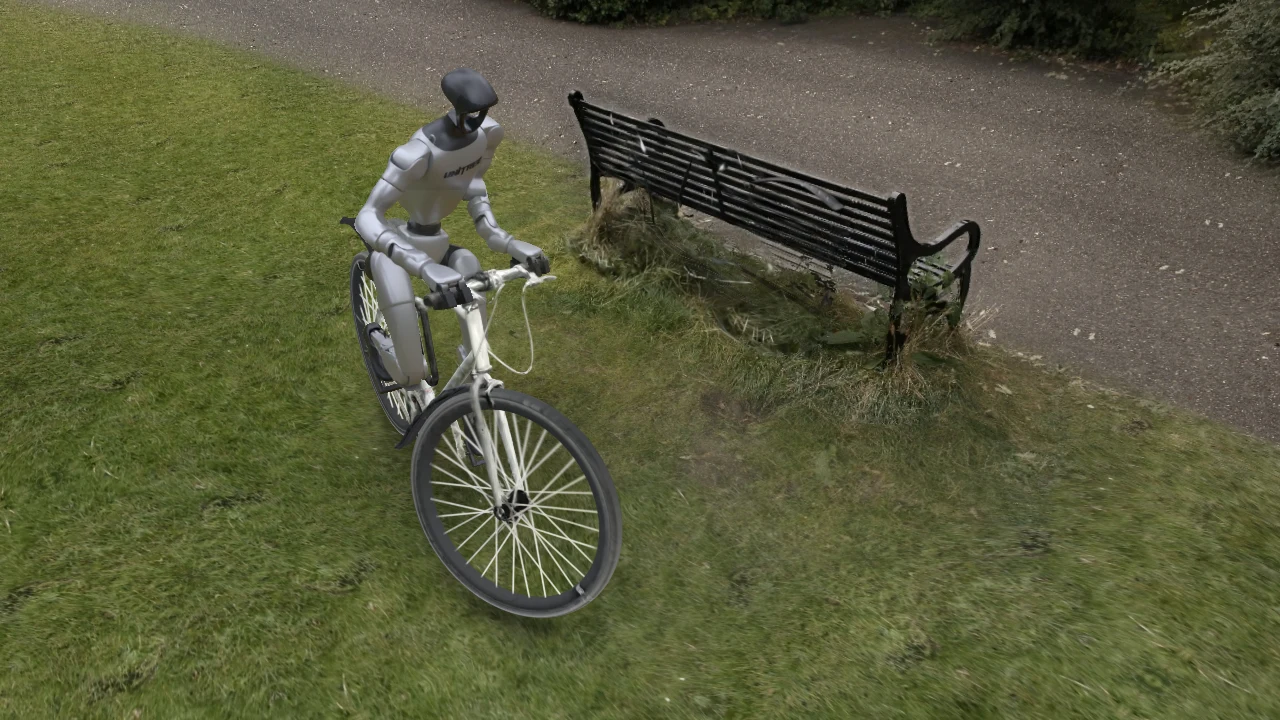
The bicycle came from 194 photographs taken outdoors for the Mip-NeRF 360 dataset. It became seven articulated nodes. They are the frame, the fork, both wheels, the crankset and both pedals.
In the scene, a Unitree G1 rolls the bicycle clear of the bench and rides a lap around it. The park around it is kept as Gaussian splats in the background.
- 02
Separate objects across a site
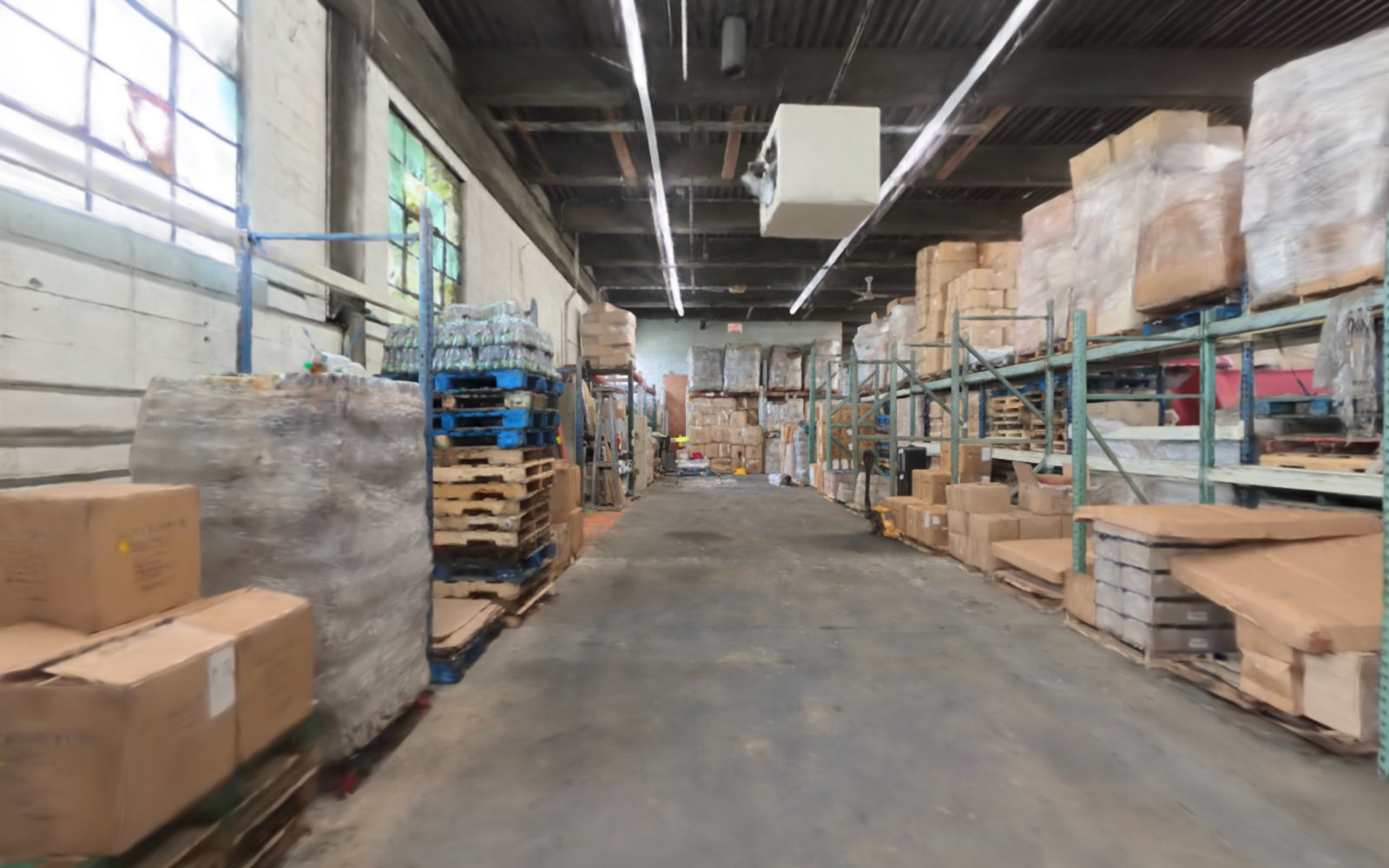
A larger site goes through the same passes. The warehouse capture gave 71 separate objects, each kept at its captured position.
Among them are two wooden pallets, a plywood sheet, a tilt truck, a shovel and some long wooden sticks.
- 03
Predict physics for each object
Each object gets a material, mass, friction and a collision shape, with a confidence score. The values are predictions. They have not been calibrated against the real objects.
None of the scenes on this site includes soil or deformable ground. Terrain calibration of the kind Bedrock describes is outside what this page shows.
- Wooden pallet, object 752
- 15.00 kg, mesh collision
- Tilt truck, object 19
- 16.00 kg, box collision
- Objects in the warehouse
- 71, of which 65 are dynamic
Construction labour and robotics in numbers
- 349,000workers US construction must add in 2026, according to ABCNCCER, 15 January 2026 ↗
- 87%of 1,830 surveyed construction firms have hourly craft openings. 88% say those roles are as hard or harder to fill.AGC and NCCER, 3 September 2026 ↗
- 4simulation roles open at Bedrock Robotics on 26 November 2026Bedrock Robotics job board ↗
- $200MSeries A raised by Gravis Robotics in August 2026 for construction autonomyThe Robot Report, 17 August 2026 ↗
More on the method
“Real-to-sim from a 3D scan” covers each step from capture to scene. “From Gaussian splat to simulation scene” covers splats like the ones these teams build of their sites.
Both pages are linked below. The warehouse page and “Articulated objects from 3D scans” are linked too. The second covers the bicycle's joints.
Questions
What is a digital twin in construction?
A digital twin in construction is a model of a real site or building that is kept up to date from data about it. Robotics teams use site twins to test machines in simulation before they run on the site. The examples on this page build them from scans and Gaussian splats.
Can I build an Isaac Sim construction site from a scan?
SceneAgent converts captures into USDZ scenes, and Isaac Sim reads USD. We have not converted a construction site. The closest example on this site is the outdoor bicycle capture.
Does SceneAgent simulate terrain or soil?
No scene on this site includes soil or deformable ground. SceneAgent separates objects from a capture and predicts physics for each one. Excavator teams such as Bedrock Robotics and Gravis Robotics describe terrain and soil work in their job posts.
Does it work with outdoor captures?
Yes. The bicycle scene came from 194 outdoor photographs in the Mip-NeRF 360 dataset. SceneAgent takes RGB video or photos, Gaussian splats, photogrammetry and LiDAR scans.