Gaussian splat to simulation
From Gaussian splat to simulation scene
A Gaussian splat shows a room from any angle, but a robot cannot touch it. SceneAgent turns the splat into separate objects with collision shapes and physics.
Why a splat alone is not enough for physics
A 3D Gaussian splat stores a scene as millions of small coloured ellipsoids. It renders a real room well from new viewpoints. It has no surfaces that a physics engine can collide with.
A splat is also one piece. A box on a shelf and the shelf itself are the same set of Gaussians. A simulator cannot lift the box out.
Engineers who bring splats into Isaac Sim also report rendering problems on NVIDIA's forums. One thread asks why a splat shows layered artifacts after conversion to USDZ. Another asks why camera exposure changes the meshes in a scene but not the splat.
From splat to scene
SceneAgent works on the splat in four stages. The examples come from the warehouse, the kitchen and the gallery.
- 01
Label every Gaussian
SceneAgent gives each Gaussian semantic features with GroundingDINO and SAM. Gaussians that belong to the same object end up with the same label.
Labels can also mark regions within one object. In the gallery, the stegosaurus skeleton's 179,692 Gaussians are grouped into 11 regions, from the skull to the tail spikes. The regions group bones. They do not name each bone.
- 02
Separate the objects
Gaussians with one label become one object. Each object keeps its place in the room.
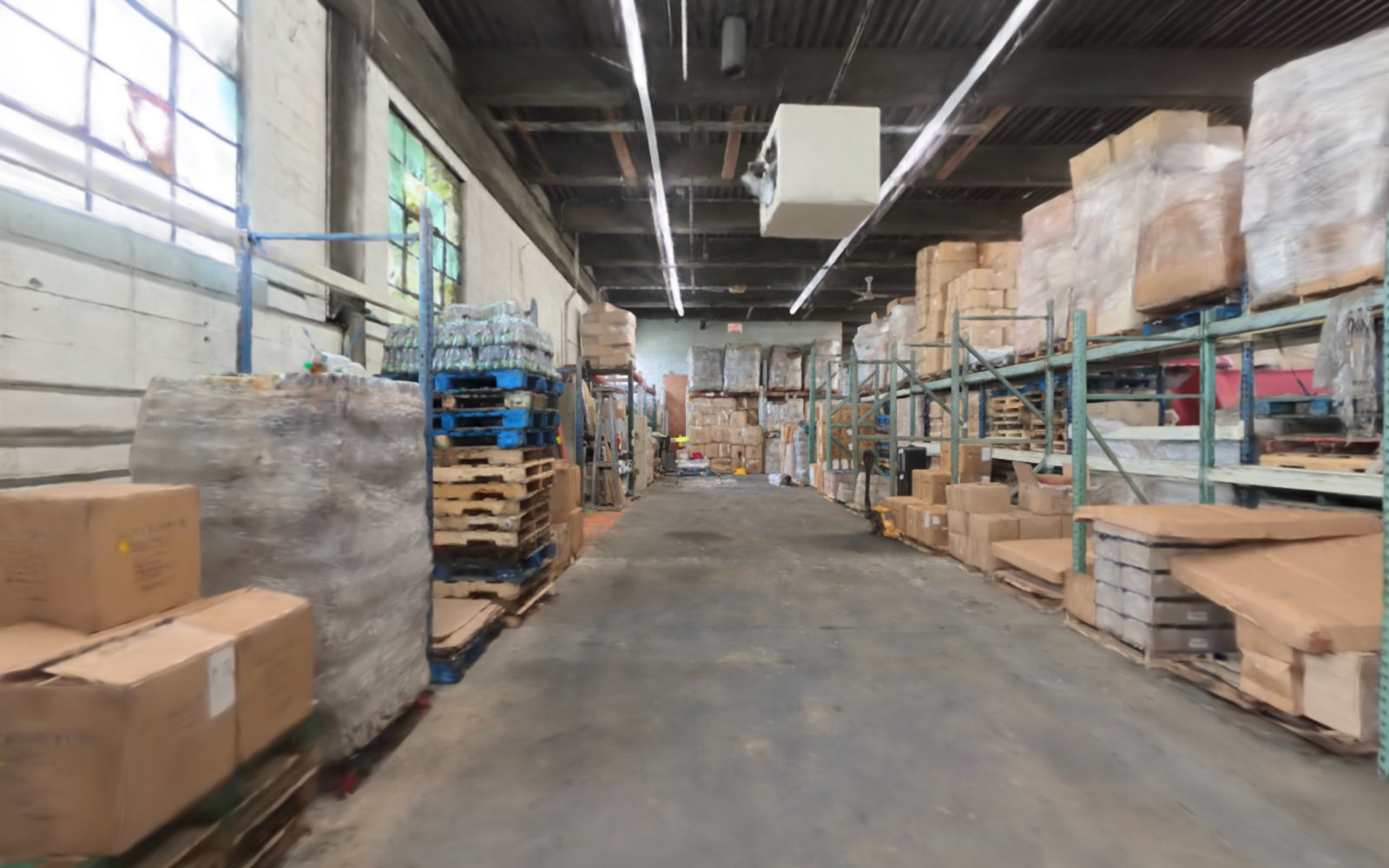
The warehouse annotations list 71 separated objects. They include 26 cardboard boxes, 16 shrink-wrapped loads, two pallet jacks and a fire extinguisher.
- 03
Give each object a collision shape
Each object record names a collision primitive. In the warehouse, 52 objects use a box, 17 use a mesh and 2 use a cylinder.
A box is cheap to simulate. A mesh follows a shape a box cannot, such as a wooden chair or a stack of pallets. In the kitchen, the 25 objects use meshes, boxes, convex hulls and one capsule.
- 04
Predict its physics
SceneAgent predicts physics priors for each Gaussian and bakes them into a material for each object. The record gives mass, density, friction, restitution and rigidity, with a confidence score.
The kitchen's wine bottle (object 6) is in the glass and ceramic class. Its predicted mass is 1.35 kg and its static friction is 0.57. A person confirmed its material class in review.
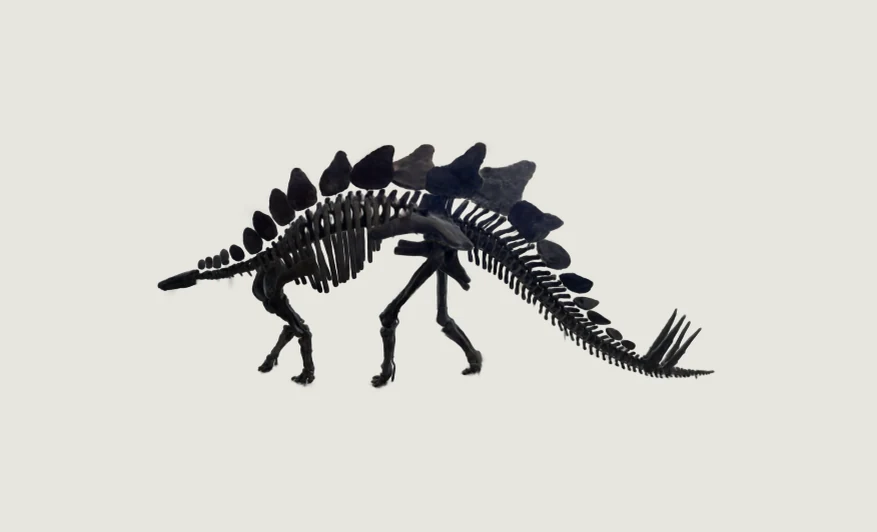
11 regions over 179,692 Gaussians.
What stays a splat
The splat is still useful after conversion. On this site, the kitchen viewer draws the room from 650,000 of the capture's Gaussians. Each converted object can be shown as its own captured Gaussians or as its mesh.
Switching between the two shows where a mesh departs from the capture. Check this before you trust a mesh for contact.
Niantic Spatial delivers each place in its Places Library as a splat and a collision mesh in one USDZ. The warehouse here came from that library. SceneAgent separated 71 objects from it, each with its own physics.
Formats in and out
SceneAgent accepts RGB video or photos, an existing 3D Gaussian splat, photogrammetry or a LiDAR scan. Over MCP, an agent can upload a splat as a PLY or SPZ file, an RGB-D scan or a video clip.
Generated splats work too. A kitchen generated with World Labs Marble went through the same passes. In the result, a Dexmate tips a leftover pizza slice back into its box.
The output is USDZ. SceneAgent packages it for Isaac Lab, MuJoCo, Unreal Engine and other simulators.
Splats in simulation, in numbers
- 8 of 25simulation job posts read on 26 November 2026 name Gaussian splatting or 3DGS. Zoox asks its engineer to bring 3DGS and NeRF reconstructions into sensor simulation.Zoox job post ↗
- 459views on an NVIDIA forum thread about a splat that shows layered artifacts after conversion to USDZNVIDIA Developer Forums ↗
- 71objects separated from the warehouse splat, each with predicted physicswarehouse annotations.json ↗
- 179,692Gaussians in the stegosaurus skeleton, grouped into 11 regionsstegosaurus-parts.json ↗
Questions
Can you convert a Gaussian splat to a mesh?
Yes. SceneAgent converts each object it separates into a mesh and gives it a collision shape. The kitchen viewer shows both versions of each of its 25 objects, so you can compare them.
Can I import a Gaussian splat into Isaac Sim?
Isaac Sim can render splats through NVIDIA's NuRec. A rendered splat does not collide with anything. SceneAgent adds separate objects with collision shapes and physics. It packages the scene as USDZ for Isaac Lab, which runs on Isaac Sim.
Which splat formats does SceneAgent accept?
An agent can upload a 3D Gaussian splat as a PLY or SPZ file. SceneAgent also takes RGB video or photos, photogrammetry, LiDAR scans and RGB-D scans.
Does the converted scene work in MuJoCo?
SceneAgent packages scenes as USDZ for Isaac Lab, MuJoCo, Unreal Engine and other simulators. The greenhouse run and the Sony radio run on this site were recorded in MuJoCo.
Does it work on generated splats?
Yes. A kitchen generated with World Labs Marble went through the same passes as the real captures on this site.