Lab and campus digital twins
Labs, campuses and science facilities
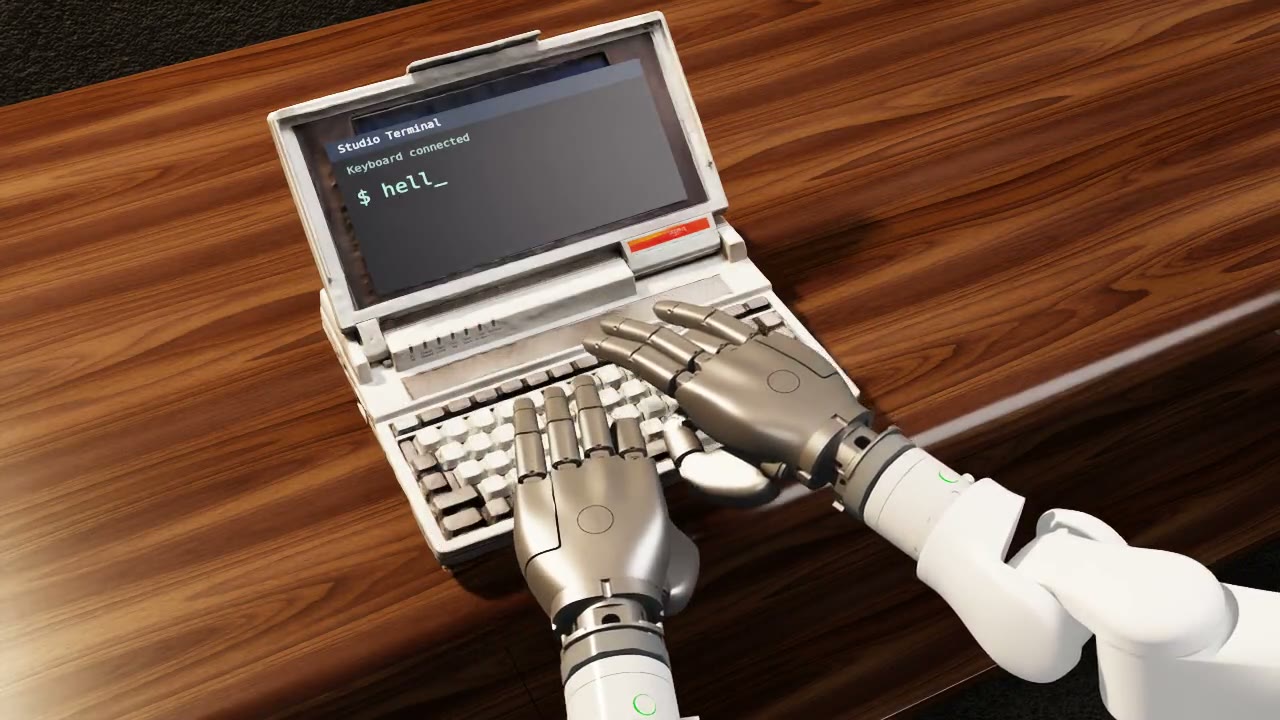
Lab automation teams plan robots against models of their own rooms. SceneAgent builds that model from a scan. Our example is a campus observatory, where a simulated Dexmate opens the dome and slews the telescope.
What lab simulation teams build
Lila Sciences hires an engineer to check arm reach and mobile robot movement in Isaac Sim against models of its labs.
Multiply Labs builds sim-ready digital twins of its robot clusters and lab from Onshape CAD. It runs policy evaluations in simulation as regression tests. The same post lists real-to-sim reconstruction from scans or video as a nice-to-have.
Research groups also build lab twins from scans. MATTERIX makes twins of real chemistry labs from 3D perception and scanning. Splat2Act used 101 scanned campus environments as Isaac Sim scenes.
Who builds lab and campus simulations
What each source says the team builds in simulation. None of these sources mentions SceneAgent.
- Multiply LabsA pipeline from Onshape CAD to sim-ready digital twins of its robot clusters and lab. Policies are evaluated in simulation as regression tests.Multiply Labs job post, 24 November 2026 ↗
- Lila SciencesAn evaluation engineer checks arm reachability and how mobile robots move in Isaac Sim, against models of its lab environments. The checks come before work on the hardware.Lila Sciences job post, 9 October 2026 ↗
- MATTERIXAn open digital twin of a chemistry lab. Twins of real labs come from 3D perception and scanning, and missing assets are made from object video with NeRFs. The authors report sim-to-real transfer.arXiv 2601.13232, 19 January 2026 ↗
- Life sciences teams in NVIDIA's BioNeMo announcementNVIDIA says HighRes Biosolutions designs lab automation in simulation first and Opentrons trains robots in Isaac Sim. It names Amgen, Automata, Roche and Transcripta Bio as building lab and manufacturing twins.NVIDIA newsroom, 12 January 2026 ↗
- Georgia Tech and Toyota Research Institute, Splat2Act101 scanned campus environments, with a median navigable area of 104.87 m², used as Isaac Sim scenes for policy training.arXiv 2610.13945, 9 October 2026 ↗
- Self-Building LabsStarting from existing infrastructure, the system builds the lab layout, a digital twin, robot skills and workflows. It was validated on a real quantum-dot synthesis.arXiv 2610.23826, 16 October 2026 ↗
A campus observatory as a simulation scene
The observatory on this site went through these steps. The numbers come from its annotations file and the recorded routine.
- 01
Scan the room
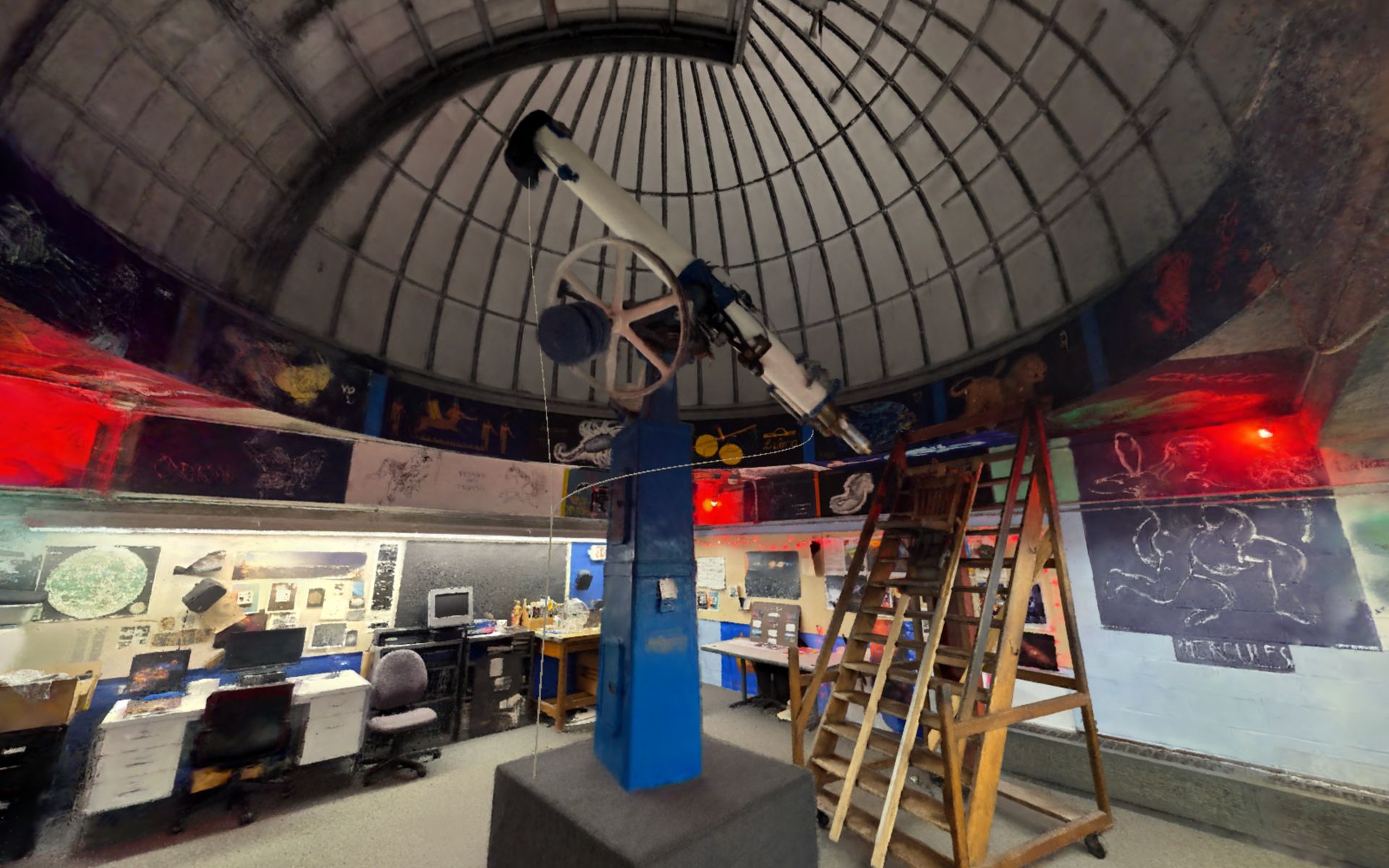
The observatory is a Matterport scan of a campus observatory. SceneAgent annotated 29 objects in it, from the telescope to an open logbook.
The prompt asked for a simulation scene for teaching a Dexmate with two Sharpa hands to operate the telescope.
- 02
Separate the instrument
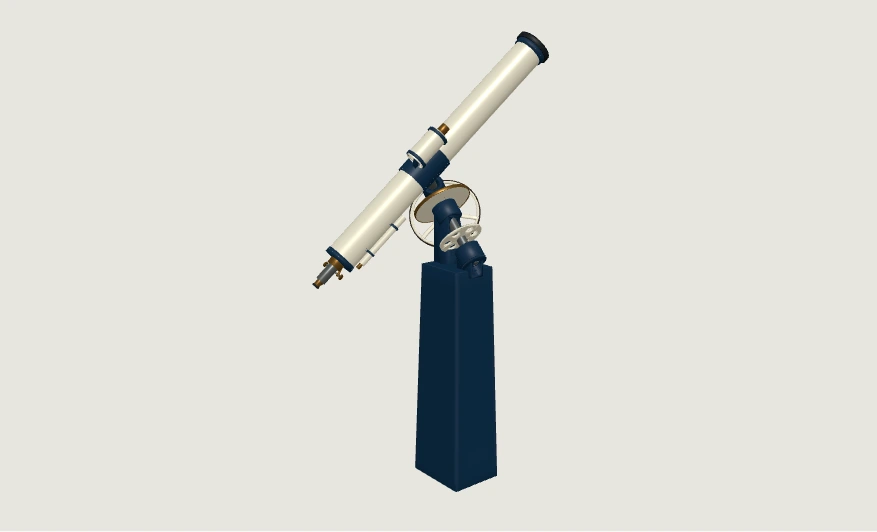
The 12-inch Alvan Clark refractor became six parts. They are the pier, the polar mount, the counterweight shaft, the optical tube, the focuser and the objective cover.
Its parts are assigned steel, copper, glass and rubber. These material classes are priors, not measurements.
- 03
Predict physics for the room
A person reviewed and accepted the material class of 28 of the 29 objects. Of the 29, 22 are dynamic and 7 are static. The static ones include the exit door, the electrical panel and the wall lever control.
For collision, 22 objects use a mesh. The physics values are estimates. They have not been calibrated against the real room.
- Tall filing cabinet, object 81
- 45.00 kg, mesh collision
- Fire extinguisher, object 140
- 5.00 kg, cylinder collision
- Logbook, object 393
- 0.45 kg, mesh collision
- 04
Teach the routine in the room
A Dexmate Vega 1 with two Sharpa Wave hands runs the opening routine in five steps over 99 seconds. It switches off the white dome light and turns the red night-vision dimmer.
It then opens the dome shutters, drives the north aisle to the pier and pulls both guide ropes to slew the telescope.
- Robot
- Dexmate Vega 1, two Sharpa Wave hands
- Actuated joints
- 70
- Shutter opening
- 70°
- Routine
- 5 steps, 99 s
Lab automation in numbers
- $6.26Blab automation market in 2025, forecast at $8.62B in 2031MarketsandMarkets, May 2026 ↗
- $550Mraised in total by Lila Sciences, at a valuation over $1.3BReuters, via Yahoo Finance ↗
- $300Mseed round for Periodic Labs to build autonomous labsSiliconANGLE, 1 October 2025 ↗
More on the method
“Articulated objects from 3D scans” covers joints like the telescope's mount and the dome shutters. “A digital twin of your site for policy evaluation” covers testing a policy in a scan of your own lab.
Both pages are linked below, with the observatory and the telescope in 3D.
Questions
What is a lab digital twin?
A lab digital twin is a simulation of a real lab, with its benches, instruments and robots. Lab teams use it to check reach and movement before they change the hardware. SceneAgent builds the room and its objects from a scan. Instruments with moving parts get joints, as the observatory telescope did.
What is a self-driving lab?
A self-driving lab runs experiments with robots and lets software choose the next experiment from the results. The term is common in chemistry and materials science. Periodic Labs raised a $300M seed round in October 2025 to build autonomous labs.
Can I build a campus digital twin for robots?
Yes. SceneAgent converts a scan of a room into a scene with separate objects and predicted physics. The observatory on this site is one campus room with 29 objects. Splat2Act used 101 scanned campus environments for policy training in Isaac Sim.
Does it work with Isaac Lab?
Yes. SceneAgent packages scenes as USDZ for Isaac Lab, MuJoCo and Unreal Engine. Isaac Lab is NVIDIA's robot learning framework, and it runs on Isaac Sim. The name refers to the software, not to a laboratory.
Can it handle lab instruments with moving parts?
Yes. In the observatory, the dome shutters, the wall controls and the telescope's mount move. The telescope itself was split into six parts. Check each joint against the real instrument before you rely on it.