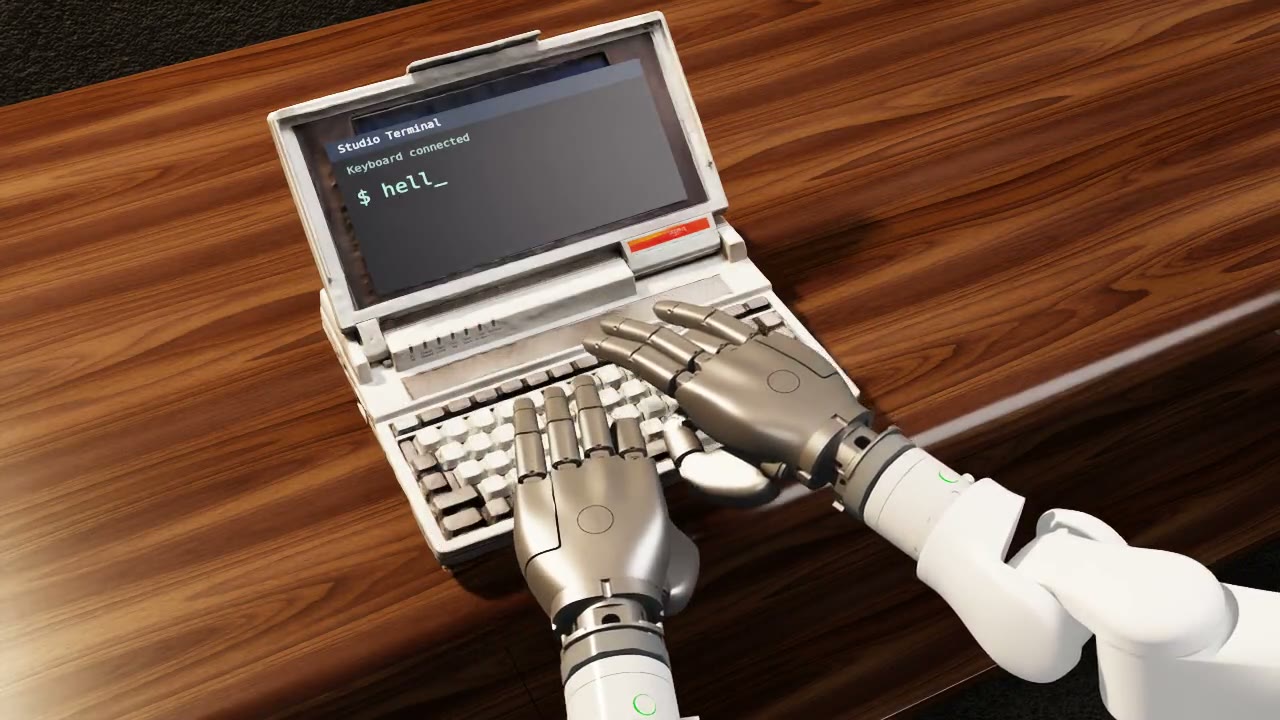
Home and humanoid robot simulation
Homes, service robots and humanoids
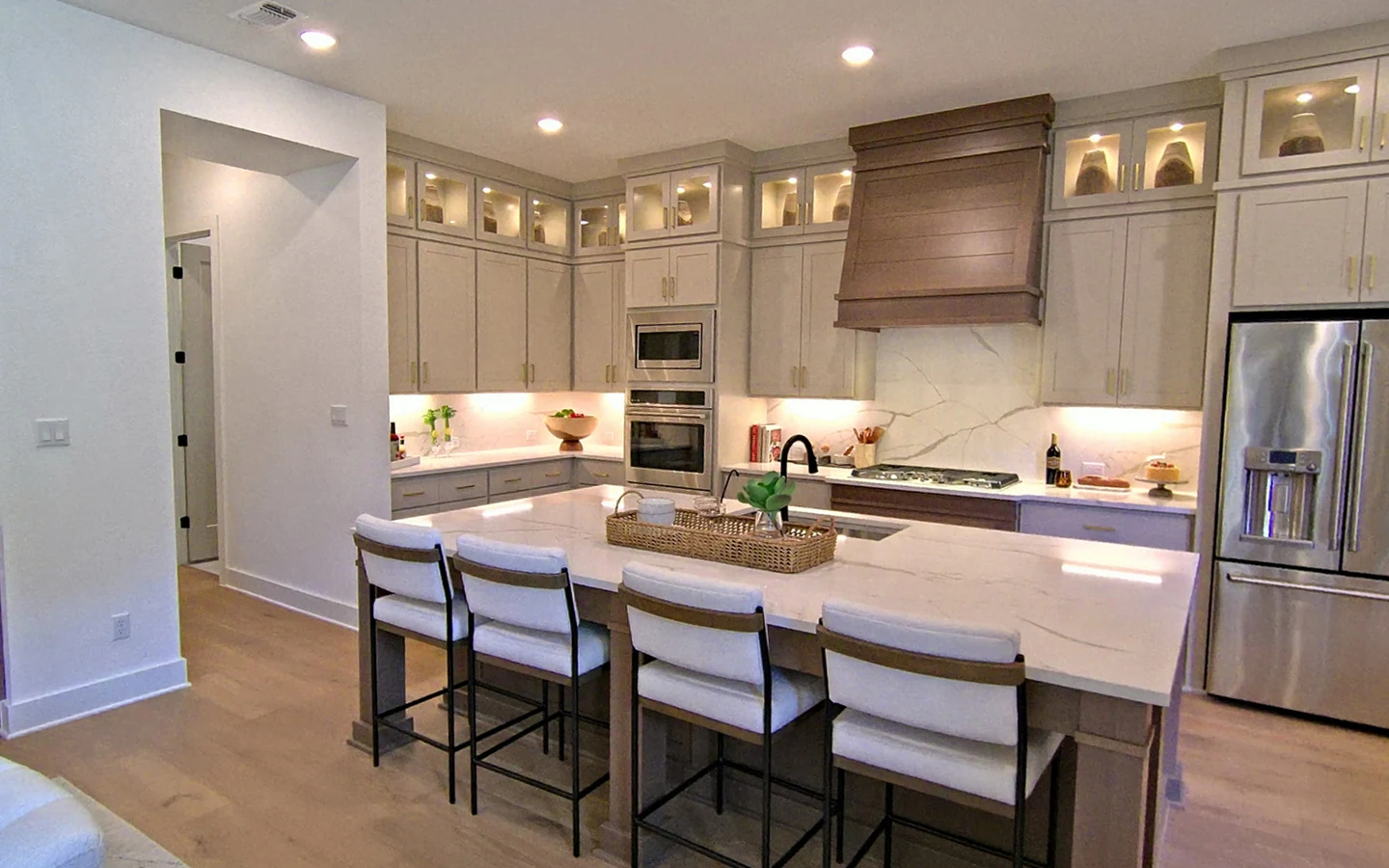
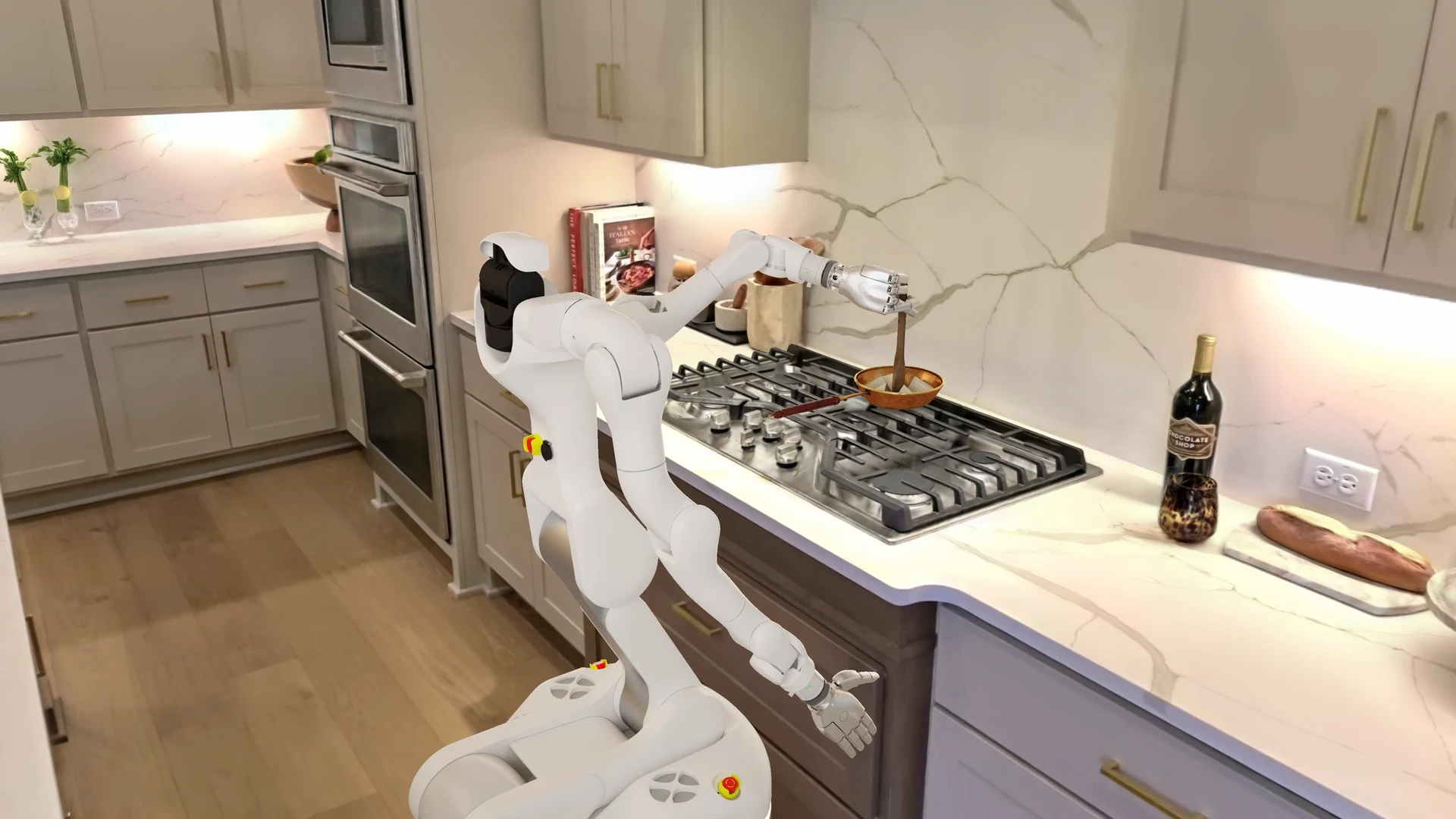
Home robots and humanoids are trained and tested in simulated homes. SceneAgent builds that home from a capture of a real one. Our example is a kitchen captured by Nucleus4D. It has 25 converted objects and a replay of a simulated Dexmate at work.
What home and humanoid simulation teams build
Humanoid teams model their own robots in detail. 1X hires for physics modelling of contact and of articulated, deformable and compliant bodies. Apptronik describes a platform of digital twins for policy training and controls validation.
They also need homes to train and test in. RoboCasa365 offers 2,500 kitchen environments built on RoboSuite and MuJoCo. Its 50 kitchen layouts are modelled on real homes from listings. They are authored, not scanned.
Other groups start from a scan of a real place. Splat2Act turns iPhone captures into Gaussian splat scenes in Isaac Sim. PolaRiS turns a camera scan of a few minutes into a scene for evaluating policies.
Who builds home and humanoid simulations
What each source says the team builds in simulation. None of these sources mentions SceneAgent.
- Georgia Tech and Toyota Research Institute, Splat2ActAn iPhone RGB-D capture becomes a Gaussian splat scene, and demonstrations are generated in batched Isaac Sim environments. 101 scanned campus scenes produced more than 68,000 pickup demonstrations.arXiv 2610.13945, 9 October 2026 ↗
- 1XA simulation engineer for the NEO home humanoid models contact and articulated, deformable and compliant bodies. The role also covers diverse environments and synthetic data.1X job post ↗
- Toyota Research InstituteIntern posts on Large Behavior Models cover synthetic demonstrations generated procedurally in simulation. The target settings are unstructured places such as homes.TRI job post, 17 November 2026 ↗
- UT Austin and NVIDIA Research, RoboCasa3652,500 kitchen environments and 365 tasks, with more than 1,600 hours of synthetic demonstrations. The 50 kitchen layouts are modelled on real homes from active Zillow listings. They are authored, not scanned.arXiv 2603.04356, March 2026 ↗
- PolaRiSA camera scan of 2 to 5 minutes becomes a Gaussian splat scene for evaluating robot policies. The authors come from UW, Princeton, Berkeley, Stanford, TRI, Physical Intelligence and other groups.arXiv 2512.16881, December 2025 ↗
- ApptronikA core simulation platform of digital twins for policy training, controls validation and CI. The post names Isaac Lab and MuJoCo.Apptronik job post, 21 October 2026 ↗
From a home capture to a simulation scene
The kitchens on this site went through these steps. The numbers come from each kitchen's records on this site.
- 01
Capture the home
Nucleus4D captured a house with a PortalCam. The capture holds 9,380,437 Gaussians.
The conversion accepted 78 objects across the house. The kitchen page shows the 25 in the kitchen and dining area, from bar stools to wine glasses.
- 02
Give each object a shape and physics
All 25 kitchen objects are dynamic. Of these, 13 are glass or ceramic. For collision, 11 use a mesh, 8 use a box, 5 use a convex hull and 1 uses a capsule.
A person reviewed and accepted the material class of 23 of the 25. The values are predictions with a confidence score. They have not been calibrated against the real objects.
- Wine bottle, object 6
- 1.35 kg, static friction 0.57
- Ceramic plate, object 34
- 0.35 kg, mesh collision
- Wine glass, object 30
- 0.25 kg, mesh collision
- Wooden chair, object 2
- 5.50 kg, mesh collision
- 03
Articulate doors, drawers and appliances
A second kitchen came from an iPhone capture in CollectData's Tidy Up dataset. The prompt asked for every door, drawer and appliance to be articulated.
In the result, a Dexmate drives round the kitchen. It opens the dishwasher, two drawers and two wall cabinets by their handles.
- 04
Split objects into parts
SceneAgent decomposes each object into parts as needed. The blender on that kitchen's counter became four parts. They are the jar, the base, the buttons and the feet.
A person reviewed the blender's material as plastic. Its parts inherit that class.
- 05
Vary the scene and test a policy
Digital sisters are versions of a scene with changed objects, placement or lighting. Over MCP, the generate_digital_sisters tool sets up a matrix of lighting, size and material.
The run_experiment_workflow tool then launches policy evaluation campaigns on those versions. Your agent reads the results back with get_experiment.
Home and humanoid robots in numbers
- Almost 34.2Mconsumer robots sold in 2025, up 37%. Most were domestic robots.IFR, 30 September 2026 ↗
- Almost 6,900full-size humanoid robots sold in 2025, from 171 known makersIFR World Robotics 2026, service robots ↗
- 63.9%success of the personalised π0.5 policy on a real Stretch 3 in Splat2Act, against 66.7% in simulationarXiv 2610.13945 ↗
More on the method
“A digital twin of your site for policy evaluation” covers testing a policy in a scan of your own home. “Articulated objects from 3D scans” covers doors, drawers and appliances.
Your coding agent can run the whole conversion over MCP. “Give your coding agent a simulation scene” shows the setup. All three pages are linked below.
Questions
Which simulators do humanoid teams use?
The humanoid job posts we read name MuJoCo, Isaac Sim, Isaac Lab, Gazebo and Warp. 1X also names PyBullet, Unreal and Unity. SceneAgent packages scenes as USDZ for Isaac Lab, MuJoCo and Unreal Engine.
Can I get an Isaac Sim kitchen environment from a real home?
Yes. Capture the kitchen and SceneAgent converts it into a scene with separate objects and predicted physics. It packages the scene as USDZ. Isaac Sim reads USD, and Isaac Lab runs on Isaac Sim.
How is a converted kitchen different from RoboCasa?
RoboCasa365 offers 2,500 authored kitchen environments and 365 tasks in RoboSuite and MuJoCo. Its layouts are modelled on real homes but not scanned. SceneAgent converts a capture of one specific home. A benchmark compares policies across many kitchens. A converted capture tests a policy in the home it will work in.
Can the robot open doors and drawers in the scene?
Yes, when the parts are articulated. In the iPhone kitchen from CollectData's Tidy Up dataset, the prompt asked for every door, drawer and appliance to be articulated. A Dexmate then opens the dishwasher, two drawers and two wall cabinets.
Can I use my own humanoid in the scene?
Yes. SceneAgent works on the place and its objects. It starts from a capture, not from a robot description. Load your robot from its own URDF, USD or MJCF into the same simulator.