Warehouse digital twins
Warehouses and logistics
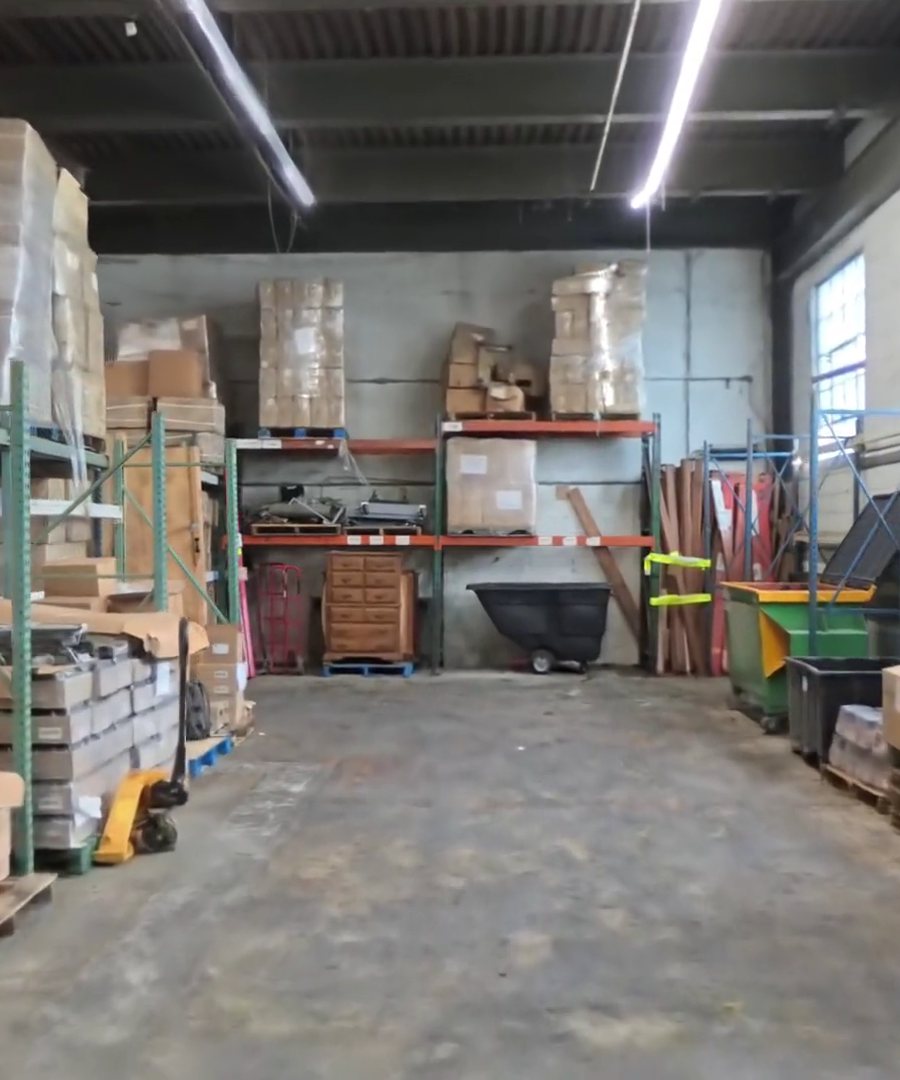
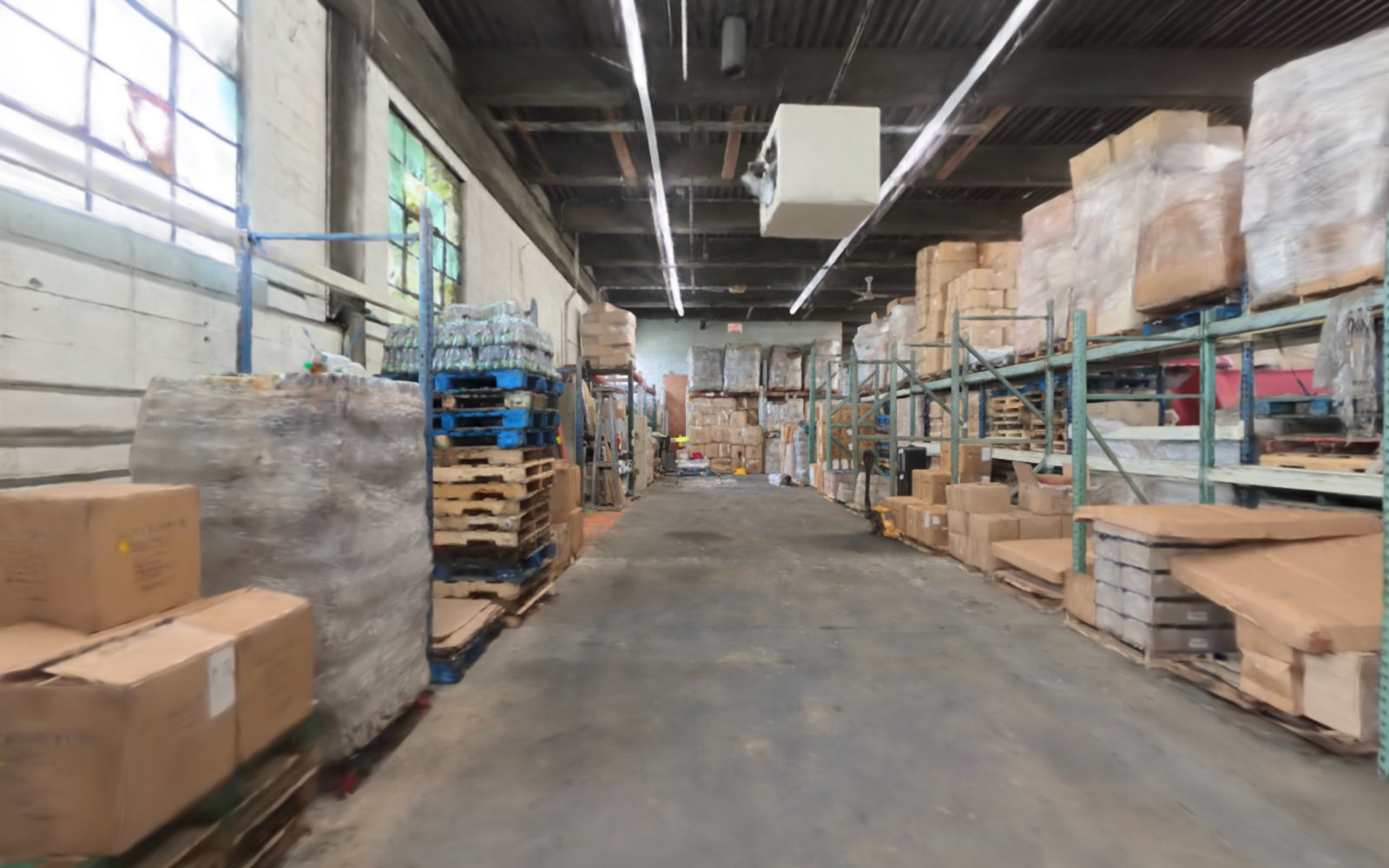
Warehouse robots are tested in simulations of the sites they will work in. SceneAgent builds that simulation from a capture of the site. Our example is a warehouse from Niantic Spatial's Places Library, with 71 separated objects.
What warehouse simulation teams build
Warehouse teams test robots in a simulation of the site before they go live. They check navigation, traffic between vehicles and the handling of goods.
Some teams build that simulation from a scan of the real building. For GXO's site in Épinoy, France, KION, Accenture and NVIDIA built a digital twin from a scan of the warehouse. Dyna Robotics hires for real-to-sim reconstruction of the rooms and aisles its robots navigate.
Not every warehouse simulator models physics. Locus Robotics simulates customer warehouses with a discrete-event simulator built from site data. Physics matters once a robot picks up or pushes the goods. Each box then needs a collision shape, a mass and a friction value.
The posts below name Isaac Sim, Isaac Lab, MuJoCo, Omniverse and Gazebo.
Who builds warehouse simulations
What each source says the team builds in simulation. None of these sources mentions SceneAgent.
- KION Group, Accenture and NVIDIASpatial scanners captured GXO's warehouse at Épinoy to create a digital twin before deployment. Vehicle behaviour, navigation and traffic conflicts are tested in it before the autonomous trucks go live.KION Group, 21 October 2026 ↗
- Dyna RoboticsA research scientist owns real-to-sim reconstruction of the facility-scale rooms and aisles its robots navigate. The pipeline continues to procedural scenes and simulation benchmarks.Dyna Robotics job post ↗
- Agility RoboticsAgility's Digit robot works in warehouses and distribution centres. A Staff Robotics Architect post asks for converting applications into digital twin simulation scenarios.Agility Robotics job post ↗
- Amazon (Fauna)A senior simulation engineer builds workflows to generate and manage scenes, assets and scenarios. The same post asks for automated evaluation and regression tests.Amazon job post, 23 October 2026 ↗
- MujinValidation runs in large simulation environments that reproduce real customer deployments. The role builds simulation components for robots, sensors and conveyors.Mujin job post ↗
- Locus RoboticsThe simulator models customer warehouses from site data and is tuned against that data. It is a discrete-event simulator, not a physics simulator.Locus Robotics job post, 6 November 2026 ↗
From a warehouse capture to a simulation scene
The warehouse on this site went through these steps. The numbers come from its annotations file.
- 01
Capture the site
The warehouse is a capture from Niantic Spatial's Places Library. Niantic delivers each place as a Gaussian splat and a collision mesh in one USDZ.
SceneAgent also takes RGB video or photos, photogrammetry and LiDAR scans. Over MCP, your coding agent uploads the capture and follows the conversion job.
- 02
Separate the objects
SceneAgent labels every Gaussian with GroundingDINO and SAM. Gaussians with the same label become one object. Each object keeps its place in the room.
The warehouse annotations list 71 objects. There are 26 cardboard boxes and 16 shrink-wrapped loads. There are also two pallet jacks, a tilt truck, a chest of drawers and a fire extinguisher.
- 03
Predict physics for each object
Each record gives a material, mass, density, friction, restitution and rigidity, with a confidence score. It also names a collision shape and says whether the object moves.
A person reviewed the material class of 70 of the 71 objects and accepted it. The values themselves are predictions. They have not been calibrated against the real goods.
- Plastic bucket, object 5
- 1.73 kg, static friction 0.54
- Cardboard box, object 352
- 1.60 kg, static friction 0.78
- Wooden pallet, object 752
- 15.00 kg, mesh collision
- Chest of drawers, object 17
- 31.77 kg, confidence 0.94
- 04
Load the scene and test a policy
SceneAgent packages the scene as USDZ for Isaac Lab, MuJoCo and Unreal Engine. In the warehouse, 65 objects are dynamic and 6 are static. Of the 71, 52 use a box for collision, 17 use a mesh and 2 use a cylinder.
Digital sisters change the objects and the lighting. In a placement experiment on this site, a π0.5 policy put a box into a bowl in 58 of 360 trials, across six box versions and six lighting setups. That experiment did not use the warehouse scene.
Warehouse robots in numbers
- 117,000transport and logistics robots sold in 2025, the largest professional service robot applicationIFR, 30 September 2026 ↗
- 1 millionrobots deployed by Amazon across more than 300 facilities, as of 30 June 2025About Amazon ↗
- $14Bforecast mobile robot revenue in 2030, up from just under $5B in 2024Interact Analysis, via CFO Dive ↗
- 60%+cut in on-site implementation time that KION reports for GXO's site at ÉpinoyKION Group ↗
More on the method
“From Gaussian splat to simulation scene” shows how a splat like this warehouse becomes separate objects. “Sim-ready assets from real objects” explains each field in an object record.
To test a policy in a scan of your own site, read “A digital twin of your site for policy evaluation”. All three pages are linked below.
Questions
What is a warehouse digital twin?
A warehouse digital twin is a simulation of one real warehouse, built from data about the site. Teams use it to test robot navigation, vehicle traffic and handling before deployment. SceneAgent builds the scene from a capture of the site and separates each object in it.
Can I get an Isaac Sim warehouse scene from a scan of my site?
Yes. SceneAgent packages the converted scene as USDZ. Isaac Sim reads USD, and Isaac Lab runs on Isaac Sim. Isaac Sim also ships sample warehouse scenes, but those are generic buildings. A converted scan is your own site with your own goods.
Which physics values does each object get?
Each object gets a material, mass, density, static and dynamic friction, restitution and rigidity, with a confidence score. It also gets a collision shape and a motion type. The values are predictions. They have not been calibrated against the real objects.
How do teams simulate warehouse robots?
Some use discrete-event simulators, which model the flow of orders and robots through a site. Locus Robotics describes one in a job post. Others use physics simulators such as Isaac Sim and MuJoCo, which model contact between robots and goods. SceneAgent builds scenes for physics simulators.
What is the NVIDIA Mega blueprint?
Mega is an NVIDIA Omniverse blueprint for testing fleets of robots in industrial digital twins. KION and Accenture name it in their warehouse work with NVIDIA at GXO. Omniverse is built on USD. SceneAgent packages its scenes as USDZ.