Policy evaluation
A digital twin of your site for policy evaluation
Test a robot policy in a simulation of the room it works in. SceneAgent builds the room from a scan. Digital sisters then change its objects, placement and lighting.
Why test in your own site
A policy can pass in a generic simulated kitchen and still fail in a real one. Counter heights, lighting and the objects on the shelves are all different.
A scan of the site puts those details into the simulation. The objects in the scene are the objects the robot will meet.
This is common work for simulation teams. Of 25 simulation job posts we read on 26 November 2026, 19 ask the engineer to train or evaluate policies in simulation. Seven use the words digital twin.
From scan to evaluation scene
The steps follow the policy loop in the SceneAgent paper. The paper describes the loop as work in progress.
- 01
Scan the site
Capture the room with the objects your robot handles. SceneAgent converts it into a scene with separate objects and predicted physics.
The campus observatory came from a Matterport scan. In its scene, a Dexmate runs the opening routine in five steps over 99 seconds.
- 02
Start from a real failure
Begin with recordings of the robot failing at the real task. Review the recordings and the robot state to find the failure mode.
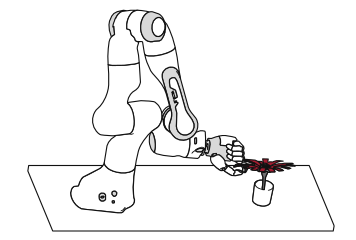
In the paper's example, a Panda with a Sharpa hand pinches a flower by its stem. The flower stays in its glass.
- 03
Vary objects, placement and lighting
Digital sisters are versions of the scene and the task. Each one changes the objects, their placement or the lighting to test a likely cause of the failure.
Over MCP, your agent can set up a matrix of lighting, size and material for a scene.
- 04
Run the same trials in each version
Run one policy across every version with the same trials. In one experiment on this site, a π0.5 policy placed a box in a bowl. The grid crossed six versions of the box with six lighting setups, with ten paired trials in each cell.
The original box under neutral light was placed in 1 of 10 trials. Under very bright light it was placed in 4 of 10. Across all 36 cells, the policy placed the box 58 times in 360 trials.
- Policy
- π0.5
- Box versions
- 6
- Lighting setups
- 6
- Trials per cell
- 10
- Placed in all cells
- 58 of 360
- 05
Train on what passes, then go back to the robot
An agent revises the controller code and reruns the task. In the flower example, the revised grasp supports the bloom from below with the palm and fingers.
Fine-tune on the simulated recordings that pass the task's success check. Compare the new and previous checkpoints on the same validation trials. Then test the new policy on the robot again.
Run the same trials in sim and on the robot
Fix the trial definition before you compare. The same start poses and the same success check should go to the simulation and to the robot.
The placement grid uses ten paired trials in every cell. Each success rate has the same count behind it, so one cell can be read against another.
Where it fits in CI
A converted scene is a USDZ file. It can be versioned next to your policy code.
A CI job can load the scene with its sisters. It can then run a fixed set of trials on each new checkpoint. The results show whether a change helped in your own site.
Over MCP, an agent can launch evaluation campaigns and read back their results. The experiments page in your account lists them.
What the posts ask for and what one grid measured
- 19 of 25simulation job posts ask the engineer to train or evaluate policies in simulation. Apptronik describes a platform of digital twins for policy training and controls validation.Apptronik job post ↗
- 7 of 25of the same posts use the words digital twin. NVIDIA's Omniverse post in Seoul covers industrial digital twins and SimReady asset validation.NVIDIA job post JR2021289 ↗
- 1 of 10trials placed the original box under neutral light in the π0.5 placement gridPlacement experiment ↗
- 58 of 360trials placed the box across all six box versions and six lighting setupsPlacement experiment ↗
Questions
Is a digital twin just a simulation?
A digital twin is a simulation of one specific place or machine, built from data about the real one. A generic simulation scene is not tied to any real site. SceneAgent builds the twin from a scan of the site.
What is a digital twin in robotics?
In robotics, a digital twin is a simulated copy of the robot's real workplace, and sometimes of the robot itself. Teams use it to train and test policies before they run on hardware.
What are digital sisters?
Digital sisters are versions of a scene or task with changed objects, placement or lighting. SceneAgent's object sisters pass generates variations of each object with geometric or visual differences.
Can I run my own policy in the scene?
Yes. The scene is a USDZ file for Isaac Lab, MuJoCo and other simulators. Load it in your own setup and run your policy as you would in any other scene.
How close is the simulated room to the real one?
The best SceneAgent run scored an F1 of 60.75% at 1 cm on a cluttered bin from GraspClutter6D. SimFoundry scored 6.9% on the same test. Physics values are predictions. They have not been calibrated against the real objects.